SRT contribution distribution
Distribute one SRT feed to multiple destinations
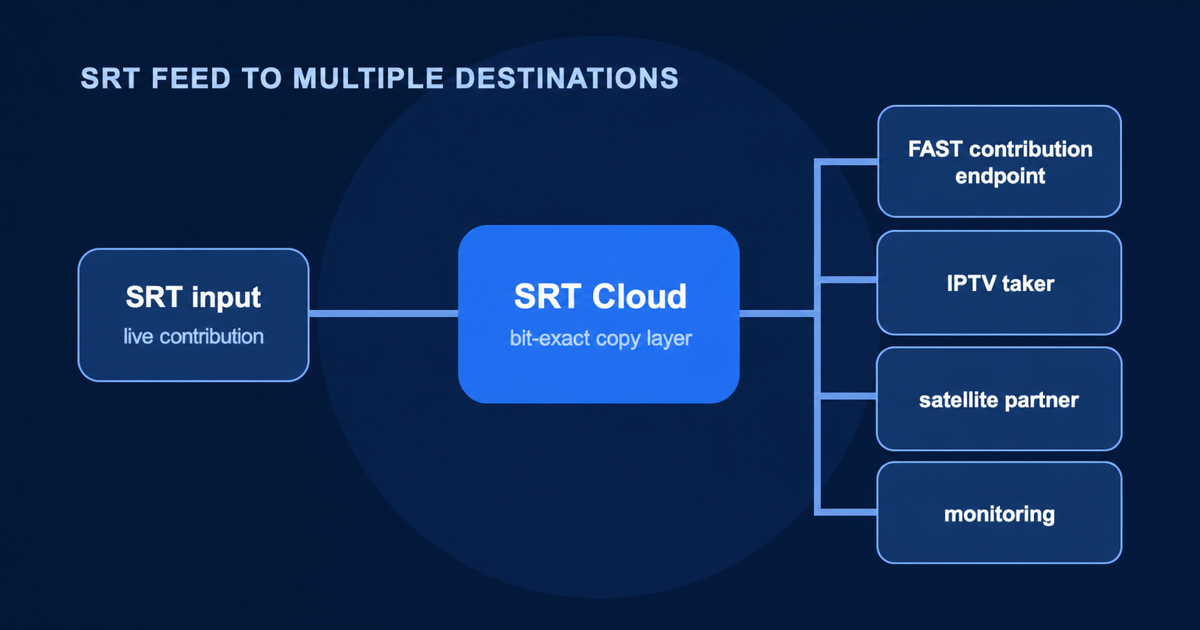
Send one live SRT contribution feed to SRT Cloud, then give each FAST, IPTV, satellite, broadcast, or backup taker its own bit-exact output. No transcoding and no local distribution hardware.
FAST viewer delivery is a separate HLS/DASH layer; this page covers the upstream SRT transport and copy leg.
How it works
One contribution feed. Independent outputs.
- 1
Send the feed
Send the live SRT contribution feed once.
- 2
Configure an output
Create one output for each downstream taker.
- 3
Share connection details
Each taker receives its own output connection details.
- 4
Adjust as needed
Add or remove outputs as distribution needs change.
Where it fits
After contribution, before delivery endpoints.
Use SRT Cloud when a prepared live feed must reach several operators, regional feeds, monitoring paths, or disaster-recovery takers. It does not replace playout, scheduling, packaging, DRM, ad insertion, or the platform that serves viewers.
When a different tool fits better
Choose a gateway or broader media platform when you need protocol conversion, routing, transcoding, playout, packaging, DRM, or ad insertion. Choose SRT Cloud for the focused job of copying one SRT input to separately configured downstream outputs.
See current per-output terms →Questions
SRT distribution, explained
Can I send one SRT feed to multiple destinations?
Yes. SRT Cloud accepts one live SRT input and creates a separately configured bit-exact output for each destination.
Does SRT Cloud deliver a FAST channel to viewers?
No. FAST viewer delivery is a separate HLS/DASH layer. SRT Cloud is the upstream SRT contribution and copy leg before downstream delivery endpoints.
Does SRT Cloud transcode the feed?
No. Each output is a bit-exact 1:1 copy of the input; SRT Cloud is not an encoder, playout system, or transcoder.
How is SRT distribution priced?
SRT Cloud is priced per output. See the pricing page for current terms.